
The animals at Disagården
Heritage Breeds
Sweden's traditional livestock breeds are an important part of our cultural heritage. At Disagården you can meet Linderöd pigs, Roslag sheep, Hedemora chickens, Jämt goats and Rödkulla cattle.
Hedemora Chickens
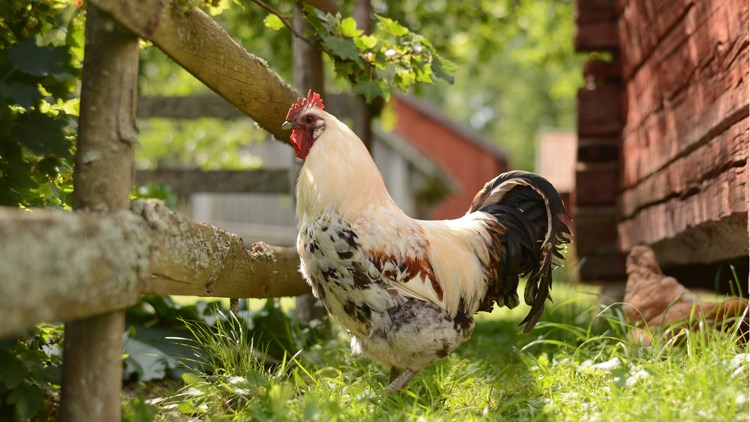
The Hedemora chicken is one of the world's northernmost native chicken breeds and has been kept in the Hedemora area of central Sweden for as long as records exist. The breed came close to extinction in the 1970s, when most traditional farm chickens were crossed with commercial laying hybrids. In 1982, a pure flock was discovered in the village of Trollbo outside Hedemora. All Hedemora chickens alive today descend from that flock.
Roslag Sheep
Roslag sheep originate from the Uppland coast and the islands of the Stockholm archipelago, where they have adapted to the local environment over many centuries. Traditionally, most farms kept a small flock to provide wool for clothing. The meat, skins and horns were also put to good use.
Linderöd Pigs
The Linderöd pig is Sweden's only remaining unimproved native pig breed. Compared with modern commercial breeds, it has a more compact, rounded body. Its snout is straight and its medium-sized ears often tilt forward, helping to shade its eyes. The colouring varies but always includes black patches on a grey-white or reddish-brown background. Hardy and active, Linderöd pigs thrive when they can roam outdoors, rooting in woodland and pasture.
Rödkulla Cattle
A typical cow in Uppland during the early nineteenth century was probably a small, reddish-brown Rödkulla. Today, Rödkulla is one of Sweden's few remaining native cattle breeds. It is a dual-purpose breed, valued for both milk and beef. The name kulla refers to the breed's naturally hornless cattle. Rödkulla cattle are red in various shades, sometimes with white markings, and are known for their calm temperament, strong legs and hooves, good fertility and easy calving. During the summer, Disagården is usually home to a Rödkulla cow and her calf for a few weeks.
