
The Historic Buildings at Disagården
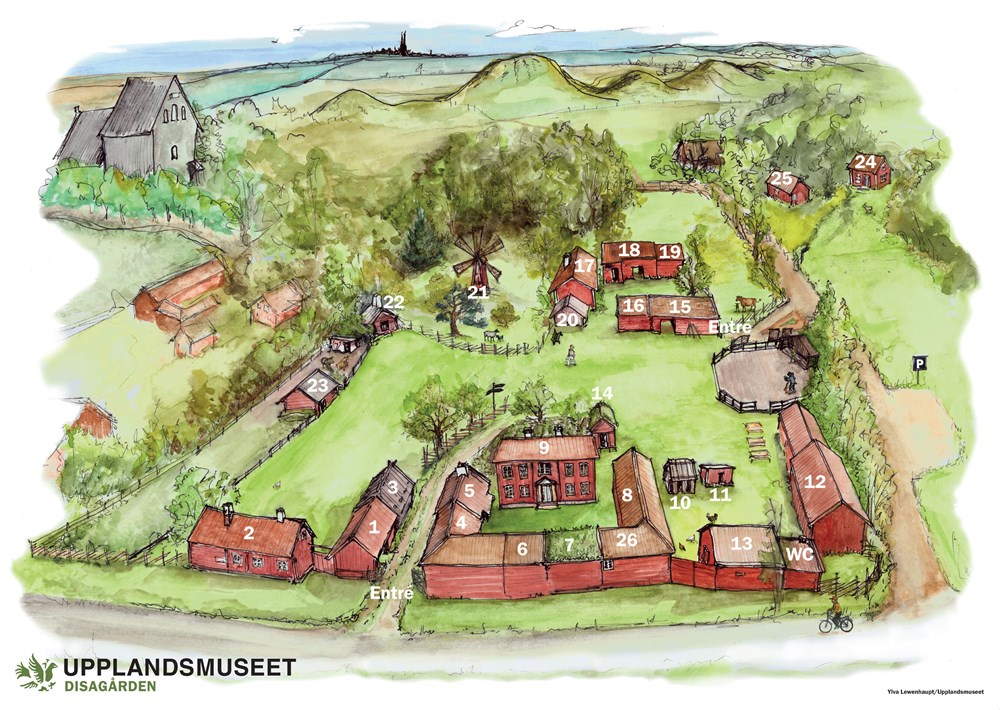
Explore more than 20 historic buildings dating from the sixteenth to the nineteenth century, carefully relocated to Disagården to recreate a traditional Uppland village.
The museum presents a farming village as it might have appeared in the mid-nineteenth century, before the Land Consolidation Reform (Laga skifte) transformed the rural landscape by dividing villages and moving many farms to new locations.
A winding village street runs through the museum, linking three farmsteads. On the outskirts stands a former soldier's croft, while the largest farm represents a typical farmstead from the fertile plains of Uppland. Here, the farmhouse, storehouses, barns and cowsheds are arranged around an enclosed farmyard, reflecting the traditional layout of the period.
The buildings were relocated from villages across Uppland and together preserve the region's rich rural building traditions.
1. Gatehouse with Storehouse
Lälunda, Old Uppsala Parish. 18th century
The wide gateposts, topped with carved decoration, were originally set deep into the ground. They are characteristic of an early building technique once common in central Uppland.
2. Farmhouse
Ytterby, Skuttunge Parish. 18th century
An extended pair-cottage, a traditional Swedish farmhouse plan with two main rooms separated by an entrance hall and an additional chamber on one side. Today the building houses the museum staff.
3. Storehouse
Borggårde, Hökhuvud Parish. 16th century
Built from six-sided hewn timber. Several construction details resemble those of Building 16. The roof is a traditional north Uppland timber roof, consisting of birch bark covered with wooden planks.
4–8. Farm Buildings from Gränby
Björklinge Parish
These five buildings all originate from the same farm.
4. Gatehouse and Storehouse
Built in 1752. The gatehouse contains a horse stable for visiting travellers, with a hayloft above.
5. Festival House with Cellar
18th century. The large reception room has a traditional three-part ceiling and painted eighteenth-century decorations directly on the timber walls.
6. Maid's Summer Chamber and Craft Workshop
Mid-18th century. The upper floor served as summer accommodation for the maid, while the ground floor was used for handicrafts.
7. Storehouse
Early 18th century. The beam above the doorway is decorated with finely carved traditional patterns.
8. Stable and Farmhand's Chamber
Stable built in 1814, with a mid-18th-century gatehouse. The external staircase leads to the summer chamber used by the farmhand.
9. Farmhouse
Nyvla, Bälinge Parish. Early 19th century
A two-storey traditional pair-cottage, with one main room on either side of the entrance hall.
10. Fattening Pigsty and Privy
Vissgärde, Ramsta Parish. Early 19th century
Pigs were kept here to be fattened before the autumn slaughter.
11. Pigsty
Lilla Bultebo, Tierp Parish. Early 19th century
12. Barn
Gråmuren, Björklinge Parish. Late 18th century
13. Cowshed
Lilla Bultebo, Tierp Parish. 19th century
14. Storehouse
Grimsta, Ärentuna Parish. Early 19th century
Storehouses such as this were often placed at some distance from the farmyard to protect valuable food stores from fire.
15. Gatehouse and Stable
Norrby, Skuttunge Parish. Built in 1864
16. Storehouse
Östanå, Morkarla Parish. Early 17th century
The upper floor projects over the entrance in a characteristic overhanging construction. The lowest timber beam and its supporting brackets are decorated with traditional carved ornament.
17. Farmhouse
Bärby, Östervåla Parish
The kitchen dates from the late eighteenth century, while the ceremonial room was added in the early nineteenth century. Inside are wall paintings from 1824 by the folk artist Hans Wikström.
18. Gatehouse with Summer Chamber and Granary Loft
Lockelsbo, Tierp Parish. Built in 1826
19. Storehouse
Lockelsbo, Tierp Parish. Early 19th century
20. Cellar Storehouse
Stora Källbo, Tensta Parish. 17th century
The construction shares several features with Building 16.
21. Windmill
Ramsta Parish
Small windmills such as this were used by village households to grind grain for their own needs.
22. Smithy
Elingbo, Tierp Parish. Late 19th century
Almost every farm had its own smithy. Because of the risk of fire, it was always built some distance from the other buildings.
23. Sauna
Inninge, Stavby Parish. Late 19th century
The sauna served many purposes besides bathing. It was used to dry grain, malt and flax, and for smoking meat and bacon.
24. Soldier's Croft
Vittulsberg, Vaksala Parish. 1860s
The croft stands on the edge of the village, reflecting its original location on the outlying land of the farms. It was accompanied by small fields and meadows. During the late twentieth century, the building stood at Polacksbacken in Uppsala before being moved to Disagården.
25. Cowshed
Trevlinge, Rasbo Parish. Late 19th century
Originally part of a soldier's croft.
