
Visit the Gamla Uppsala archaeological site
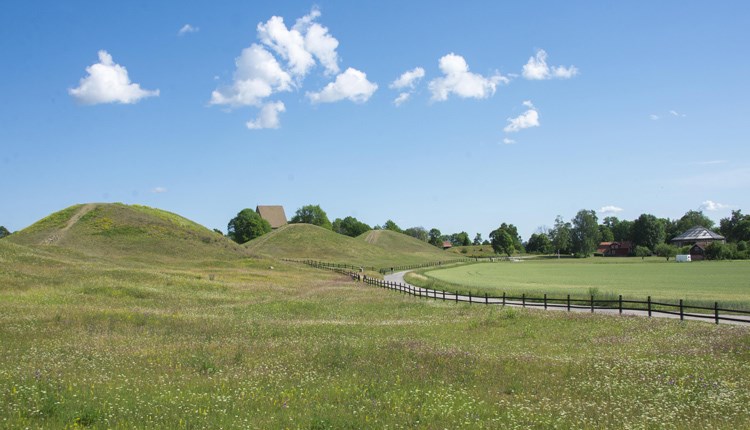
Welcome to Old Uppsala Discover one of Scandinavia's most important archaeological sites, home to the royal mounds, Sweden's first cathedral and the open-air museum Disagården.
Welcome to Gamla Uppsala
Gamla Uppsala is an ideal destination for a full day's visit. Explore the archaeological site with its monumental Royal Mounds, enjoy the surrounding walking trails, and visit Sweden's first cathedral, which became a parish church after the archbishop's seat was moved to present-day Uppsala.
The area is also home to Disagården Open-Air Museum, where you can experience what a nineteenth-century farm village in Uppland looked like.
The Archaeological Landscape
During the Iron Age, Old Uppsala was the centre of a prosperous and highly organised society. A royal estate stood here, and the Svear gathered to worship their gods. The site remained an important religious centre even after Christianity was established in Sweden.
For centuries, legends claimed that the great mounds contained the remains of the ancient Norse gods, while others believed they were simply natural hills. In 1846, Sweden's National Antiquarian, Bror Emil Hildebrand, began the first archaeological excavation of what was then known as Odin's Mound, now called the Eastern Mound. On 15 September, the excavation reached the centre of the mound, where a stone cairn was uncovered.
Burials of Powerful People
The excavation confirmed that the mound was a burial monument containing cremated human remains and fragments of grave goods. In 1874, archaeologists excavated the Western Mound, then known as Freyr's Mound, where they discovered another cremation burial.
Although we do not know who was buried in the Royal Mounds, they were almost certainly members of the highest social elite. Finds from the Eastern Mound included the remains of a helmet and fragments of gold objects. In the Western Mound, archaeologists discovered the remains of a goshawk, probably a trained hunting bird, a powerful symbol of high status during the Iron Age.
A Thriving Settlement
The discoveries made by Hildebrand and later archaeologists represent only a small part of what was once a large and flourishing settlement. During the sixth century AD, when the Royal Mounds were constructed, Old Uppsala was at the height of its power. Skilled craftspeople, prosperous farms, a royal estate and a great feasting hall were all located here.
The feasting hall may have inspired the medieval chronicler Adam of Bremen, who in the eleventh century described a magnificent pagan temple decorated with gold. He also wrote of an evergreen tree and a sacred spring where sacrifices were made to the Norse gods.
The First Church
There is strong evidence that the first Christian church in Old Uppsala was built during the eleventh century. In 1164, Sweden's first archbishop's cathedral was constructed on the same site beside the royal estate.
The church standing today is only about half the size of the original cathedral, but traces of the medieval walls can still be seen inside the present building. In 1270, the archbishop's seat was transferred to Östra Aros, the settlement that later became modern Uppsala. The cathedral became a parish church and acquired its present appearance during the fifteenth century.
Despite these changes, Old Uppsala has retained its symbolic importance throughout Swedish history. Its significance was recognised once again in 1989, when Pope John Paul II visited the site.
A Story Still Unfolding
The story of Old Uppsala continues to evolve as new archaeological discoveries deepen our understanding of this remarkable place.
One of the largest archaeological investigations ever undertaken in the area took place in 2012, when approximately 70,000 square metres were excavated ahead of the construction of a new double-track railway. The excavation uncovered extensive evidence of settlement, ritual activity and monumental structures, adding important new knowledge about one of Scandinavia's most significant archaeological sites.
